
Synthetic Division Method
I have to admit, synthetic division is probably the most “fun” method for dividing polynomials. It’s more straightforward than polynomial long division and involves fewer steps to get to the answer. In this lesson, I’ll walk you through five examples that should help you get comfortable with the basic steps needed to divide polynomials using synthetic division.
Things to Remember:
- Make sure the dividend is in standard form. That means the powers are in decreasing order.
- The divisor must be in the form [latex]x – \left( c \right)[/latex].
Examples of How to Divide Polynomials Using the Synthetic Division
Example 1: Divide the polynomial below.

Let us re-examine the given problem and make the necessary adjustments, if necessary.
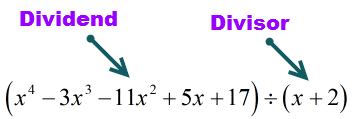
The dividend, which is what we’re dividing, is already in standard form because the exponents are arranged in decreasing order. That’s exactly what we want!
The divisor needs to be rewritten as

Now, we can set up the synthetic division by pulling out the coefficients of the dividend and lining them up across the top.
Directly to the left side, place the value of [latex]c = – 2[/latex] inside the “box”.
Finally, construct a horizontal line just below the coefficients of the dividend.
Steps:
1. Drop the first coefficient below the horizontal line.
2. Multiply that number you drop by the number in the “box”. Whatever its product, place it above the horizontal line just below the second coefficient.
3. Add the column of numbers, then put the sum directly below the horizontal line.
4. Repeat the process until you run out of columns to add.
See the animated solution below:
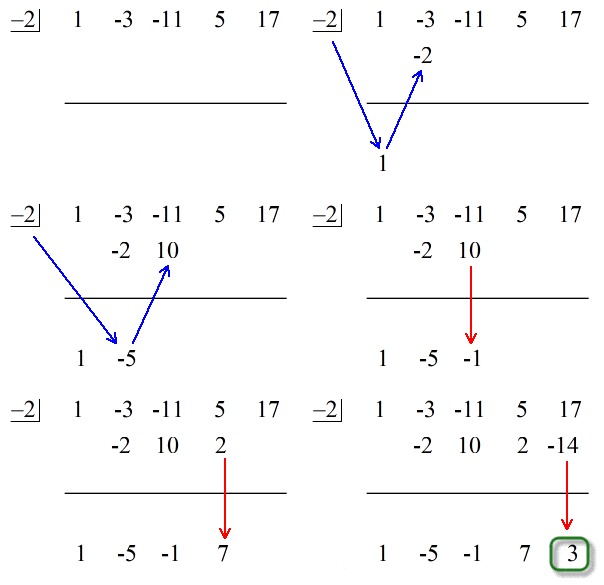
The last number below the horizontal line is always the remainder! The remainder of this problem is [latex]3[/latex].
So how do we present our final answer?
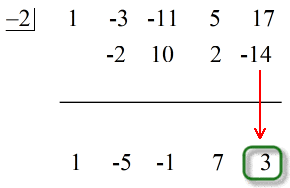
- Show your final answer in the form
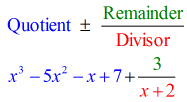
Notice that the numbers below the horizontal line except the last (remainder) are the coefficients of the Quotient.
More so, the exponents of the variables of the quotient are all reduced by [latex]1[/latex].
Example 2: Divide the polynomial.

This isn’t a trick question. You might notice that the quotient doesn’t include every exponent of the variable \(x\).
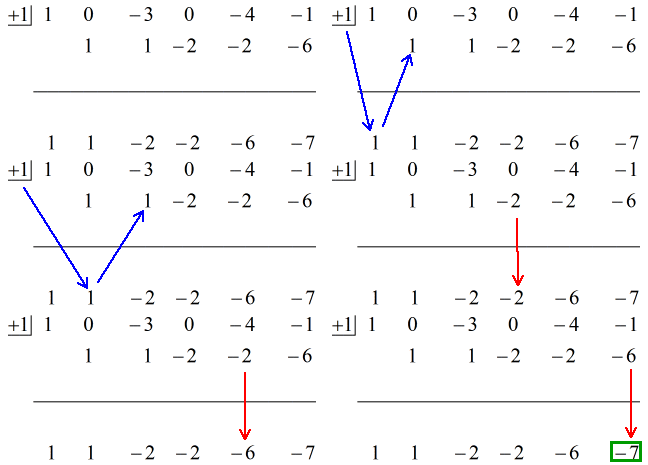
I can see that we’re missing (x^4) and (x^2) in the quotient. To include all the coefficients of the variable (x) in decreasing order, we should rewrite the original problem like this: add zeroes for the missing (x) terms. Also, express the divisor as (x – (c)), which clearly shows the value of (c), in this case, (c = +1).

From this point, I can now set up the numbers to continue with the process.
Steps:
1. Drop the first coefficient below the horizontal line.
2. Multiply that number you drop by the number in the “box”. Whatever its product, place it above the horizontal line just below the second coefficient.
3. Add the column of numbers, then put the sum directly below the horizontal line.
4. Repeat the process until you run out of columns to add.
See animated solution below:
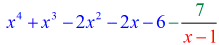
So putting the final answer in the form

we have
Example 3: Divide the polynomial below.
[latex]\left( { – 2{x^4} + x} \right) \div \left( {x – 3} \right)[/latex]
This is getting more interesting! The quotient looks pretty rough because it’s missing quite a bit. Not only are \(x^3\) and \(x^2\) missing, but the constant term is also gone.
To fix this, I’ll rewrite the original problem to make sure all the \(x\) terms are accounted for. And most importantly, don’t forget to include the missing constant, which is zero.
The “new and improved” problem should look like this:

From here, proceed with the steps as usual.
Steps:
1. Drop the first coefficient below the horizontal line.
2. Multiply that number you drop by the number in the “box”. Whatever its product, place it above the horizontal line just below the second coefficient.
3. Add the column of numbers, then put the sum directly below the horizontal line.
4. Repeat the process until you run out of columns to add.
See the animated solution below:
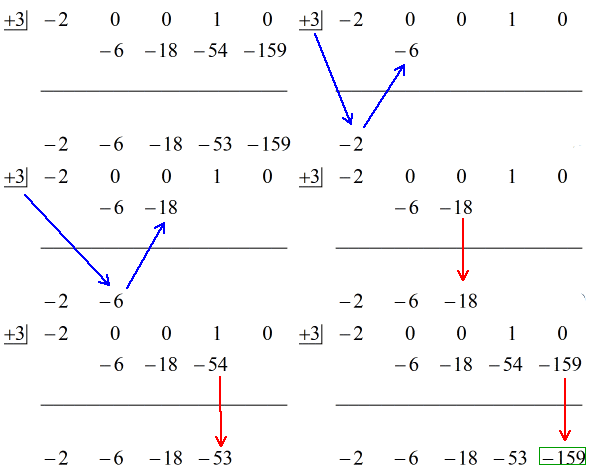
Okay then, the final answer for this is

You can write the final answer in two different ways. The first method is to use the minus or subtraction symbol to show that the remainder is negative. The second method is to use the (+) symbol and then place a negative sign directly on the numerator. Both approaches convey the same meaning!
Example 4: Divide the polynomial below.
[latex]\left( { – {x^5} + 1} \right) \div \left( {x + 1} \right)[/latex]
Don’t let this problem discourage you! It’s actually quite easy, especially now that you’ve gone through a few examples. Just remember to “fill in the missing parts,” right?
Take a look at the dividend, and you’ll see that the missing parts are \(x^4\), \(x^3\), \(x^2\), and \(x\).
Rewriting the original problem that is synthetic-division ready, we get

We populated the missing [latex]x[/latex]’s with zeros and explicitly solve for [latex]c = -1[/latex].
Steps:
1. Drop the first coefficient below the horizontal line.
2. Multiply that number you drop by the number in the “box”. Whatever its product, place it above the horizontal line just below the second coefficient.
3. Add the column of numbers, then put the sum directly below the horizontal line.
4. Repeat the process until you run out of columns to add.
See the animated solution below:
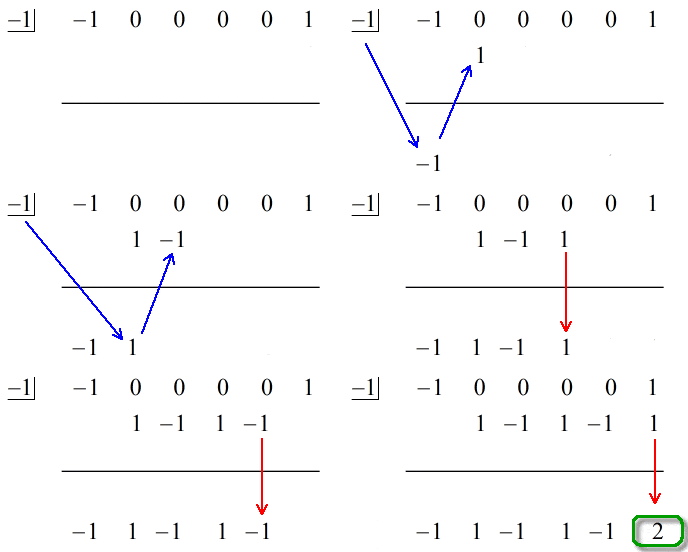
The last number below the horizontal line will always be the remainder. Don’t forget that. In this case, the remainder equals [latex]2[/latex].
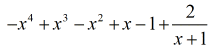
Our final answer is
Example 5: Divide the polynomial by a binomial.

In this example, we’ll end up with a remainder of zero. When that happens, it means the divisor is a factor of the dividend—in other words, the divisor divides the dividend evenly.
Looking at the problem, I can see that there are no missing components. All powers of (x) are present, and we also have a constant. That’s perfect! This problem is all set for synthetic division.
Steps:
1. Drop the first coefficient below the horizontal line.
2. Multiply that number you drop by the number in the “box”. Whatever its product, place it above the horizontal line just below the second coefficient.
3. Add the column of numbers, then put the sum directly below the horizontal line.
4. Repeat the process until you run out of columns to add.
See animated solution below:
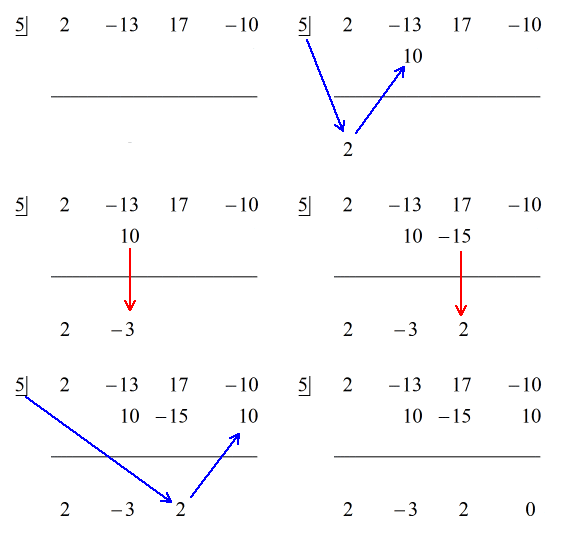
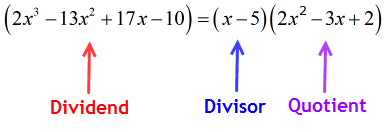
Because the remainder equals zero, this means the divisor [latex]x – 5[/latex] is a factor of the dividend

therefore
You might also like these tutorials:
- Adding and Subtracting Polynomials
- Dividing Polynomials using Long Division Method
- Multiplying Binomials using FOIL Method
- Multiplying Polynomials