
How to Convert Between Degrees and Radians
One radian is the measure of the angle at the center of a circle when the arc it cuts off is the same length as the circle’s radius. The “angle at the center of a circle” is also known as the central angle.
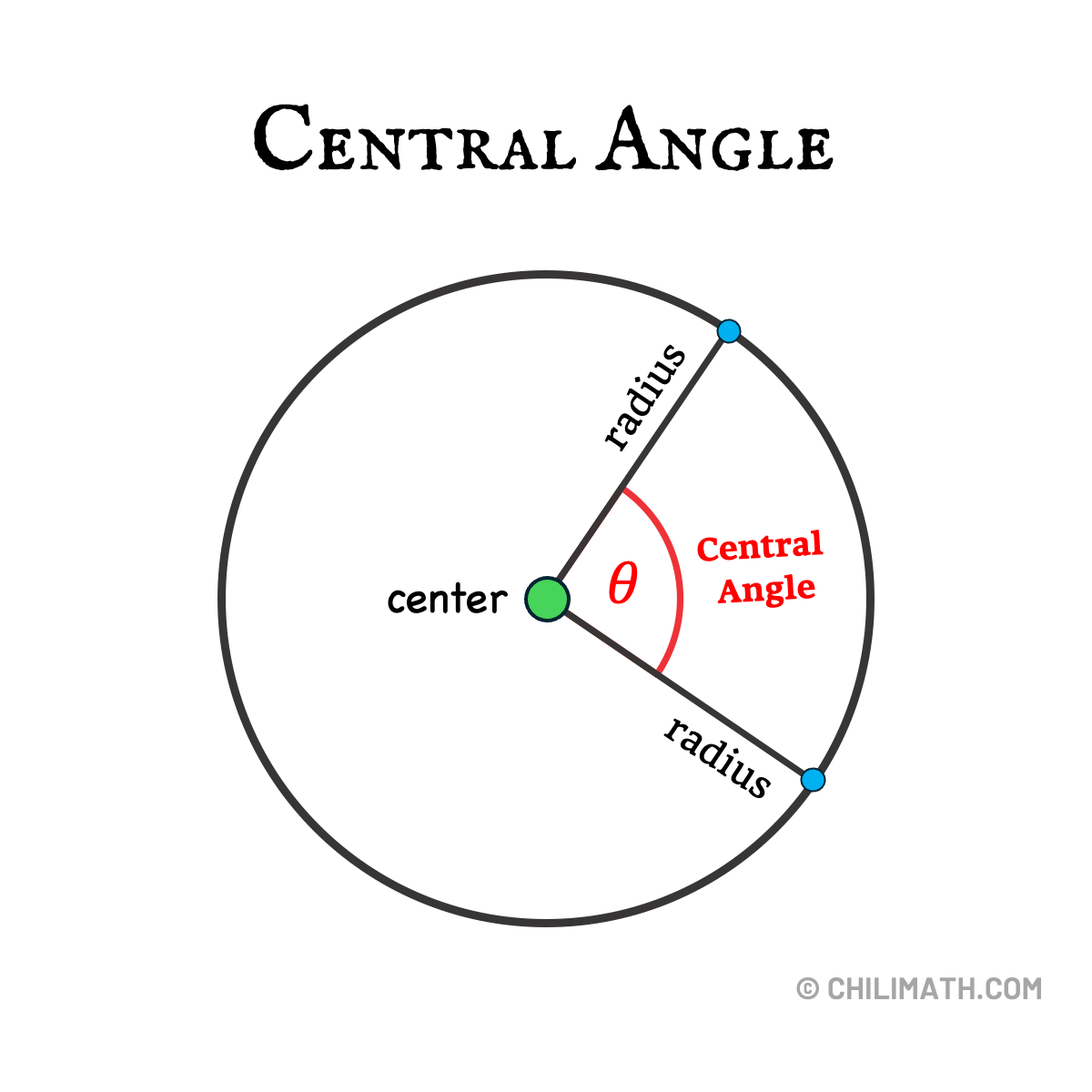
A central angle is an angle whose vertex is located at the center of a circle. The sides of the central angle are formed by the radii of the circle.
The formula to determine the measure of a central angle (\(\theta\)) in radians can be generalized with the help of the following illustration.
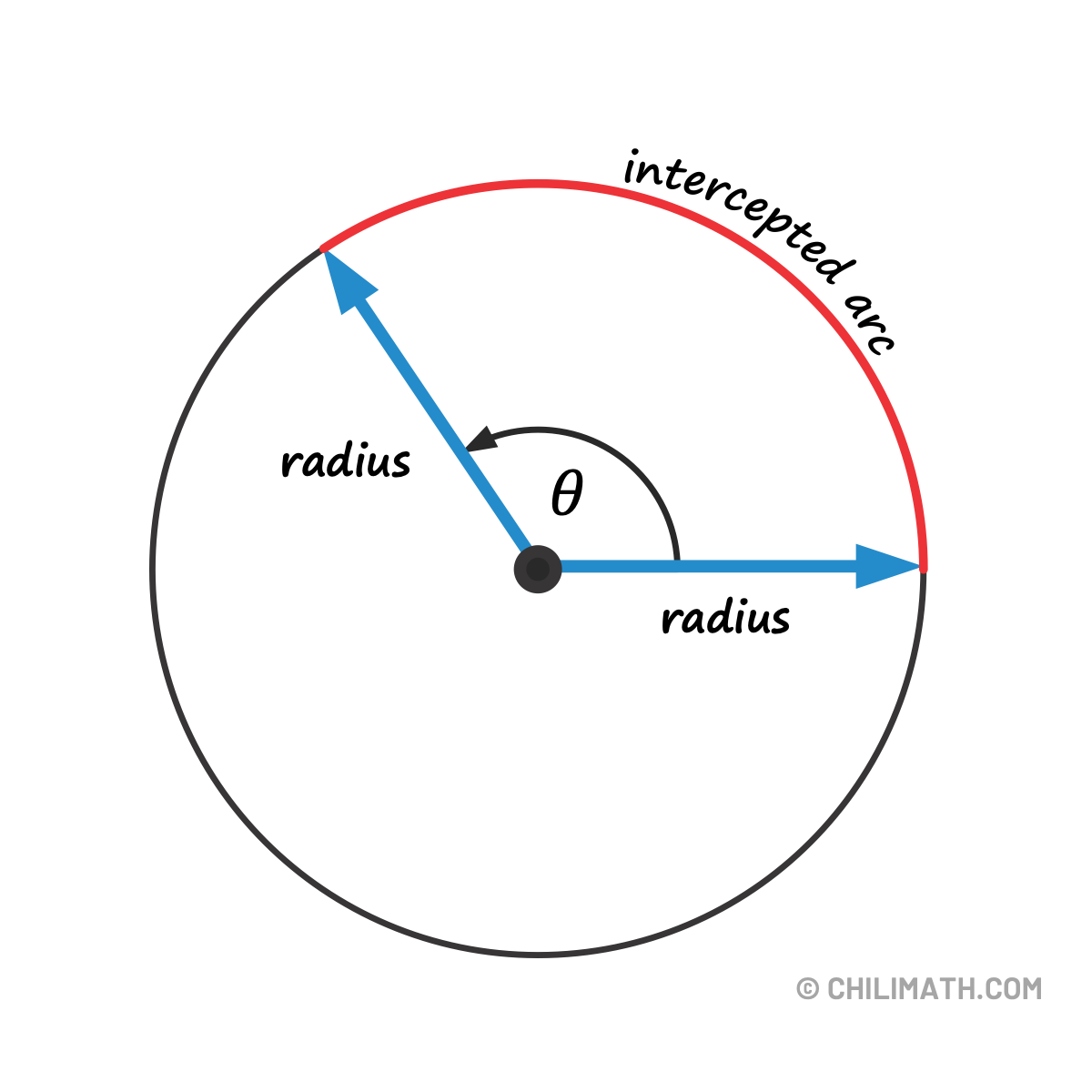
\(\theta ={\Large {s \over r}}\) \(\text{radians}\)
where:
\(\theta\) – measure of central angle in radians
\(s\) – arc length (intercepted arc)
\(r\) – length of radius
Let’s demonstrate this with an example using the formula above.
What is the radian measure of a central angle in a circle with a radius of 5 inches, if it intercepts an arc that is 16 inches long?
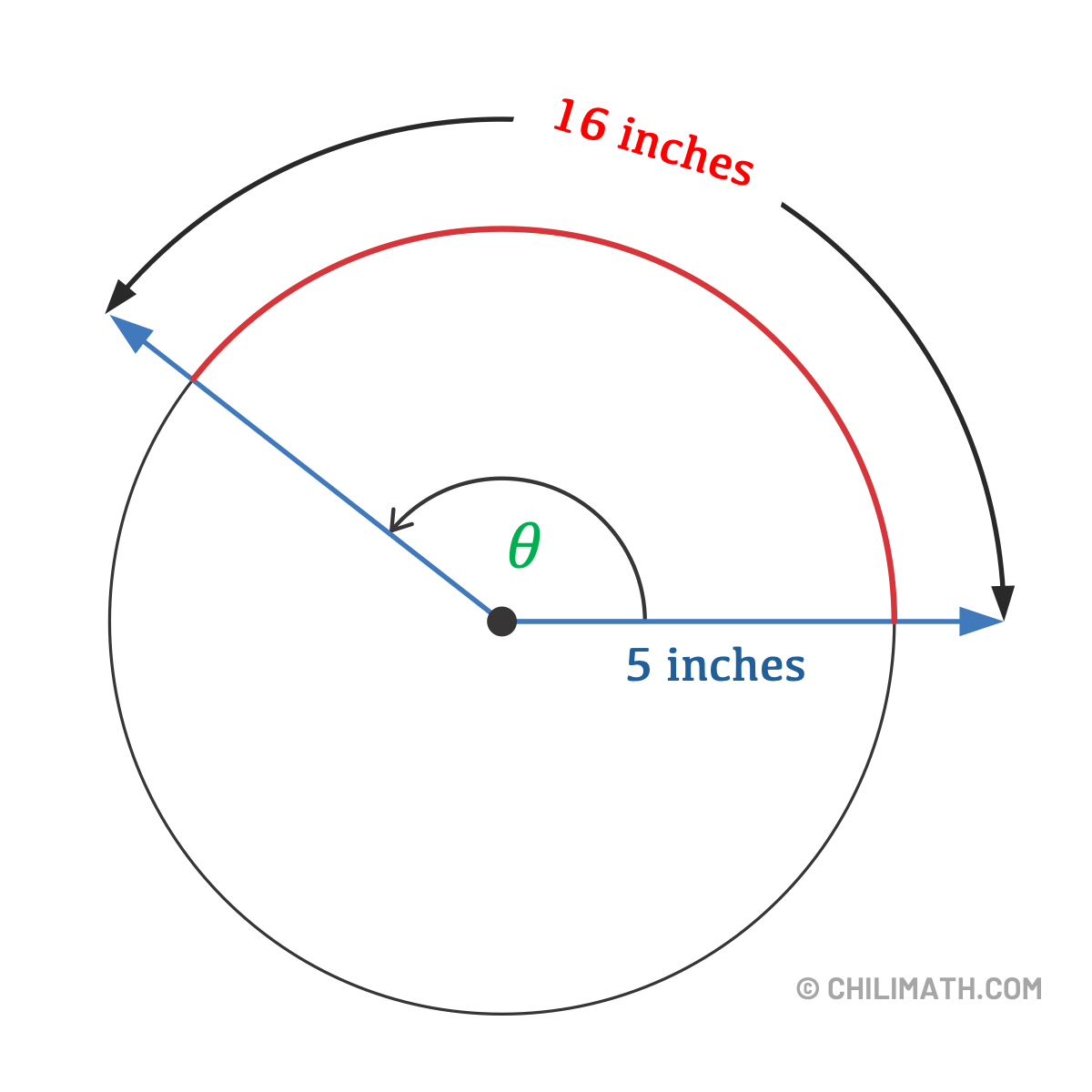
A central angle’s radian measure is calculated by taking the arc length it intercepts, \(s\), and dividing it by the radius of the circle, \(r\). In this case, the length of the intercepted arc is \(16\) inches while the radius is \(5\) inches.
Let’s plug in the values into the formula and solve.
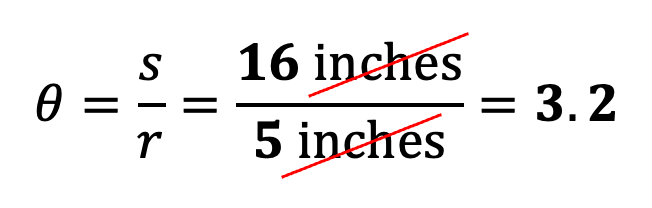
Therefore, the radian measure of the central angle \(\theta\) is \(3.2\).
Next, let’s explore the connection between degrees and radians. To figure this out, we’ll compare how many degrees and how many radians make up one full or complete rotation of an angle. In terms of degrees, a full rotation measures \(360\) degrees. However in radians, we don’t know just yet. However, we can find that out by following the steps outlined above and applying the formula we discussed which is \(\theta ={\Large {s \over r}}\) where \(s\) is the length of the intercepted arc and \(r\) is the radius.
Remember, the circumference of the circle with radius \(r\) is \(2\pi r\). Notice that the circumference acts as the length of the arc.
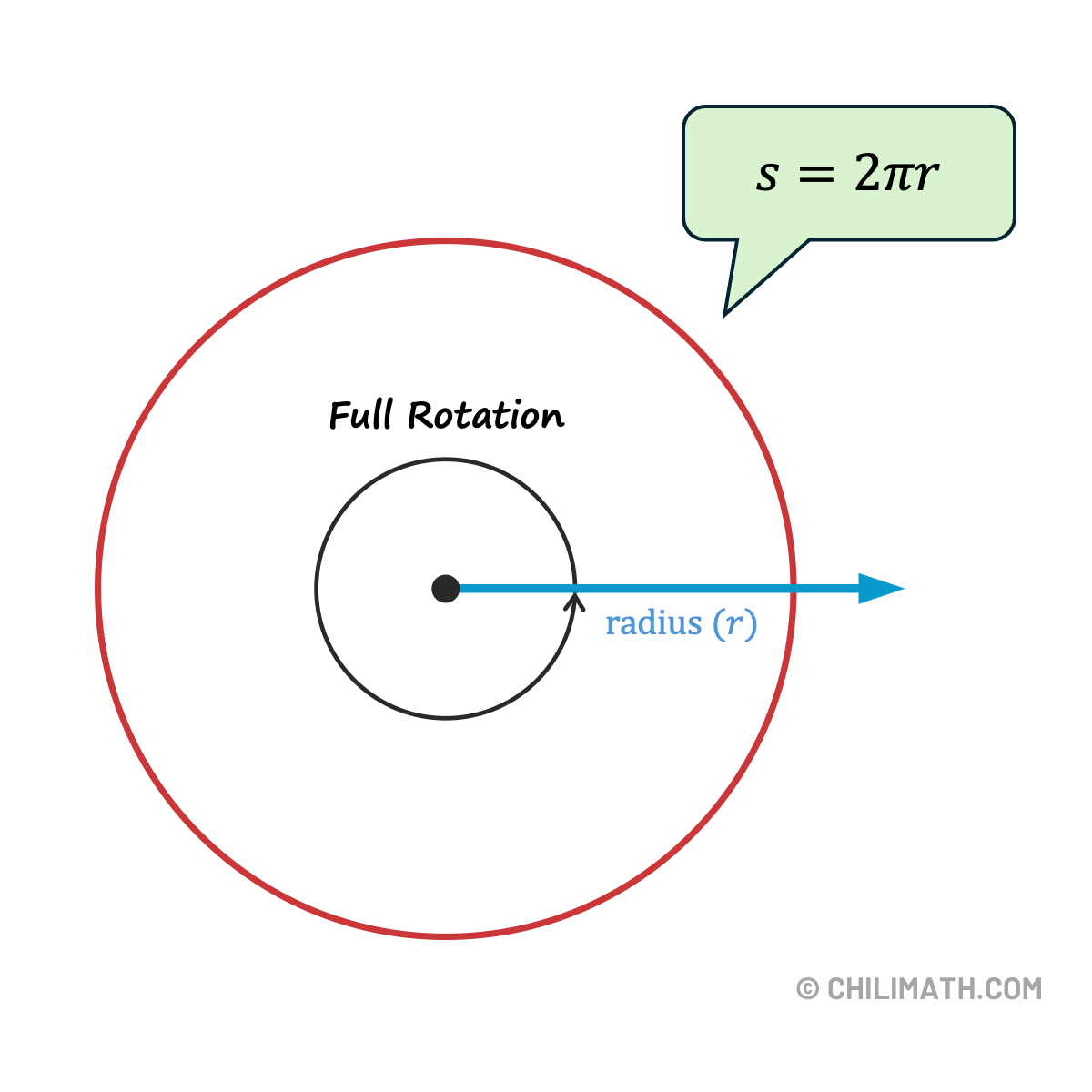
Let’s substitute the given information into the formula and check the result.
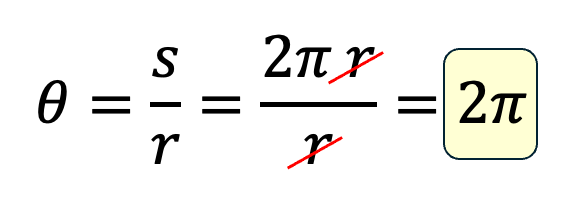
Therefore, for one full rotation the measure of an angle in radians is \(2 \pi\).
At this point, we can directly compare the angle measure of a full rotation in degrees with its corresponding measure in radians. To reiterate, the full rotation of an angle in degrees is \(360\) degrees while \(2 \pi\) in radians. This implies,
\(360^\circ\) \(=\) \(2\pi\) radians
If we divide both sides by \(2\), we get
\(180^\circ\) \(=\) \(\pi\) radians
Therefore, the conversion factors that we can use to convert from degrees to radians or from radians to degrees are

Examples of Converting Degrees to Radians
Example 1: Convert \(45^\circ\) to radians.
To convert \(45^\circ\) to radians, multiply the degrees by \(\Large{{{\pi \,\text{radians}} \over {180^\circ }}}\). During this calculation, the degrees unit cancels out, leaving the result in radians. We will also need to simplify the fraction. In this case, we can divide the numerator and denominator by \(45\).

Therefore, \(45^\circ\) is equal to \(\Large{{{\pi \,} \over 4}}\)radians.
Example 2: Convert \(150^\circ\) to radians.
To convert \(150^\circ\) to radians, multiply the degrees by \(\Large{{{\pi \,\text{radians}} \over {180^\circ }}}\). Since the units of degrees are present in both the numerator and the denominator, they will cancel each other out. Then, divide the top and bottom by \(30\) to simplify the fraction.
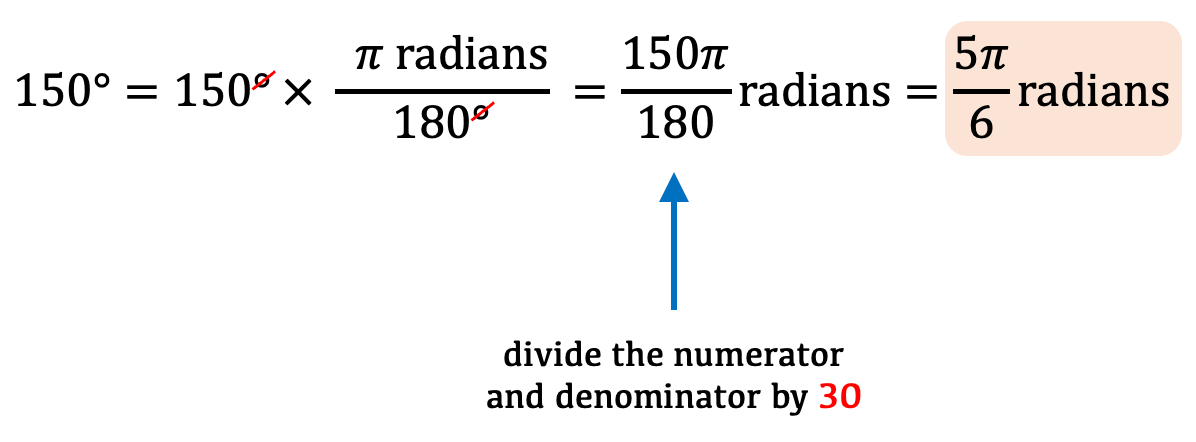
Therefore, \(150^\circ\) is equal to \(\Large{{{5\pi \,} \over 6}}\)radians.
Example 3: Convert \(-270^\circ\) to radians.
In the previous two examples, we dealt with positive angles. This time, we are going to work with a negative angle. However, the procedure is very similar.
To convert \(-270^\circ\) to radians, multiply the degrees by \(\Large{{{\pi \,\text{radians}} \over {180^\circ }}}\). The unit of degrees will cancel out since it appears in both the numerator and denominator, leaving only the unit of radians. Since the greatest common divisor (GCD) of \(-270\) and \(180\) is \(90\), let’s divide the numerator and denominator by \(90\) to simplify the fraction.
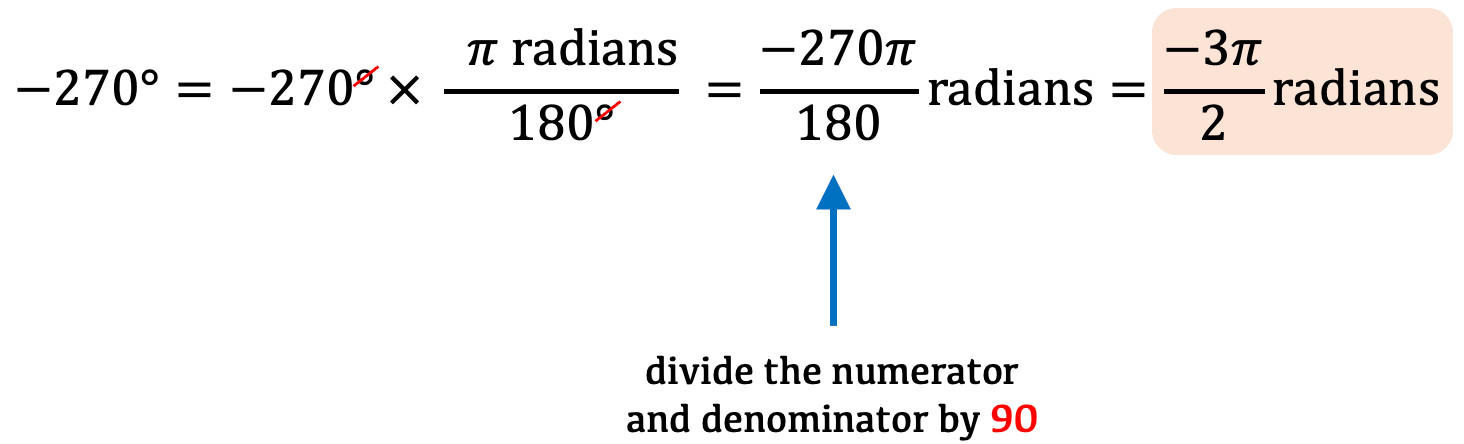
Therefore, \(-270^\circ\) is equal to \(\Large{{{ – 3\pi \,} \over 2}}\) radians.
Examples of Converting Radians to Degrees
Example 1: Convert \(\Large{{{\pi \,} \over 6}}\) radians to degrees.
To convert \(\Large{{{\pi \,} \over 6}}\) radians to degrees, multiply the radian measure by \(\Large{{{180^\circ } \over {\pi \,\text{radians}}}}\). In the calculation, the radians cancel out, leaving you with degrees in the final result. We also need to simplify the fraction by dividing the numerator by the denominator.

Therefore, \(\Large{{{\pi \,} \over 6}}\) radians is equal to \(30^\circ\).
Example 2: Convert \(\Large{{{4\pi \,} \over 3}}\) radians to degrees.
To convert \(\Large{{{4\pi } \over 3}}\) radians to degrees, multiply the radian measure by \(\Large{{{180^\circ } \over {\pi \,\text{radians}}}}\). When you perform this conversion, the radian units cancel out, leaving only degrees. Finally, reduce the fraction by dividing the numerator by the denominator.

Therefore, \(\Large{{{4\pi \,} \over 3}}\) radians is equal to \(240^\circ\).
Example 3: Convert \(\Large {{-7\pi } \over 4}\) radians to degrees.
Let’s convert a negative radian measure into degrees.
Similarly, we will multiply the radian measure by the conversion factor \(\Large{{{180^\circ } \over {\pi \,\text{radians}}}}\). Since “radians” appear in both the numerator and denominator, they cancel each other out. As for the last step, reduce the fraction to its lowest terms.

Therefore, \(\Large {{-7\pi } \over 4}\) radians is equal to \(-315^\circ\).
You Try
Problem 1: Convert \(210^\circ\) to radians.
Answer
\(\Large{{7\pi } \over 6}\) radians
Problem 2: Convert \(300^\circ\) to radians.
Answer
\(\Large{{5\pi } \over 3}\) radians
Problem 3: Convert \(-225^\circ\) to radians.
Answer
\(\Large{{-5\pi } \over 4}\) radians
Problem 4: Convert \(\Large{{3\pi } \over 2}\) radians to degrees.
Answer
\(270^\circ\)
Problem 5: Convert \(\Large{{7\pi } \over 4}\) radians to degrees.
Answer
\(315^\circ\)
Problem 6: Convert \(\Large{{-11\pi } \over 6}\) radians to degrees.
Answer
\(-330^\circ\)
You might also like these tutorials:
Converting Between Degrees and Radians Practice Problems