
Segment Addition Postulate
The Segment Addition Postulate states that if points \(A\), \(B\), and \(C\) are collinear, where point \(B\) lies between points \(A\) and \(C\), then the sum of the lengths of line segments \(\overline{AB}\) and \(\overline{BC}\) is equal to the length of the entire segment \(\overline{AC}\).

Let’s go over some examples!
Examples of Segment Addition Postulate
Example 1: Find the length of segment \(KM\). See the illustration below.
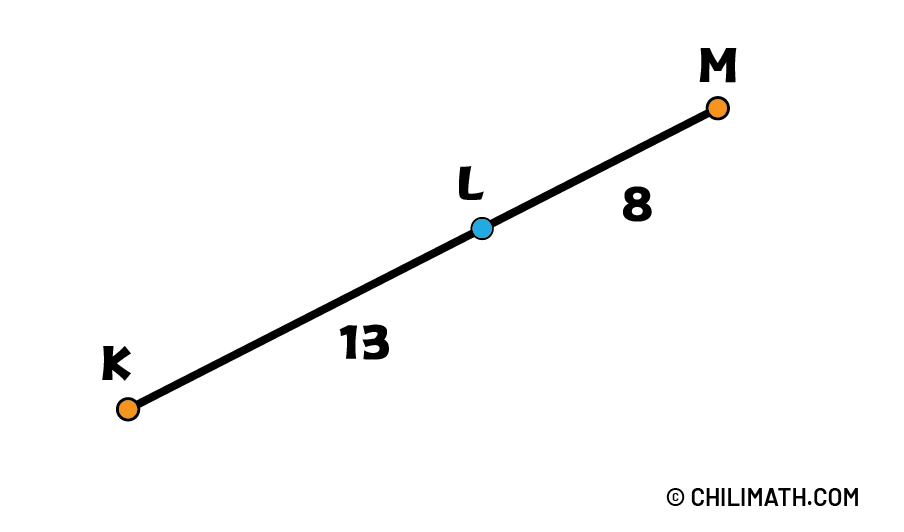
To solve this using the Segment Addition Postulate, we need to recognize that point \( L \) is between points \( K \) and \( M \) on the line. The postulate tells us that the total length of segment \( KM \) is the sum of the lengths of segments \( KL \) and \( LM \).
We can write the problem in equation form as
\(KM = KL + LM\)
From the diagram, we know that:
\( KL = 13 \)
\( LM = 8 \)
Now, let’s substitute these values into the equation.
\begin{align*} KM &= KL + LM \\ KM &= 13 + 8 \\ \end{align*}Adding \(13\) and \(8\) together, we get:
\begin{align*} KM &= KL + LM \\ KM &= 13 + 8 \\ KM &=21 \end{align*}Therefore, the total length of segment \( KM \) is \( 21 \).
Example 2: Find the length of segment \(QR\). See illustration below.

This problem involves the segment addition postulate, which states that if three points—\( Q \), \( R \), and \( S \)—are collinear, the total length of the segment \( QS \) is equal to the sum of the lengths of the segments \( Q R\) and \( RS \).
In the diagram, we know that the entire length of segment \( QS \) is \(31\) and the length of segment \( RS \) is \(7\).
Using the segment addition postulate, we can express the total length as
\( QS = QR + RS \)
By substituting the known values, the equation becomes
\( 31 = QR + 7 \)
To isolate \( QR \), we subtract \(7\) from both sides of the equation,
\( 31-7 = QR + 7-7 \)
\( 24 = QR \)
Therefore, the length of line segment \(QR\) is \(24\).
Example 3: Determine the length of segment \(BC\). See illustration below.

This diagram involves applying the Segment Addition Postulate. According to this postulate, if point \(B\) is between points \(A\) and \(C\), then:
\(AB + BC = AC\)
These are the values that we know.
\begin{align*} AB &= 9 \\ BC &= 2x \\ AC &= 31 \end{align*}
Let’s set up the equation using the Segment Addition Postulate then substitute the known values.
First, subtract \(9\) from both sides then divide by \(2\) to isolate the variable \( x \):
We can substitute \( x = 11 \) back into the expression for \( BC \) which is \(2x\) to find the length of \( BC \):
Therefore, the length of line segment \(BC\) is \(22\).
Example 4: Determine the lengths of segments \(FG\) and \(GH\). See illustration below.

We are given a line segment \( \overline{FH} \), which is split into two smaller segments by point \( G \). The length of \( \overline{FG} \) is represented by \( 3x – 6 \), the length of \( \overline{GH} \) is given as \( 5x + 9 \), and we know the total length of \( \overline{FH} \) is \(107\).
According to the Segment Addition Postulate, the sum of the lengths of the segments \( \overline{FG} \) and \( \overline{GH} \) should equal the total length of \( \overline{FH} \)
\(FH = FG + GH\)
Let’s plug in the known values.
\(107 = (3x – 6) + (5x + 9)\)
Now, let’s simplify the right-hand side by combining like terms.
Finally, we subtract both sides by \(3\) then divide by \(8\).
\begin{align*} 107 &= 8x + 3 \\ 107-3 &= 8x + 3-3 \\ 104 &=8x \\ 13&=x \end{align*}
Now that we know \( x = 13 \), we substitute this value back into the expressions for \( \overline{FG} \) and \( \overline{GH} \) to get their actual lengths.
For line segment \(FG\), we have
\begin{align*} FG &= 3x – 6 \\ &= 3(13) – 6 \\ &=39 – 6 \\ &= 33 \end{align*}For line segment \(GH\), we have
\begin{align*} FG &= 5x + 9 \\ &= 5(13) + 9 \\ &=65 + 9 \\ &= 74 \end{align*}Therefore, the length of segment \(FG\) is \(33\) while the length of segment \(GH\) is \(74\).
Example 5: Find the length of segment \(XZ\). See illustration below.

The Segment Addition Postulate states that if point \( Y \) lies between points \( X \) and \( Z \) on a line segment, then the sum of the lengths of the segments \( XY \) and \( YZ \) equals the length of the entire segment \( XZ \).
In the diagram we know that we are given three expressions for the segments:
\( XY = 8x – 11 \)
\( YZ = 4x + 1 \)
\( XZ = 10x + 22 \)
We substitute the expressions in the equation derived from Segment Addition Postulate.
\begin{align*} XY + YZ &= XZ \\ (8x – 11) + (4x + 1) &= 10x + 22 \end{align*}We combine similar terms on the left side of the equation.
\begin{align*} (8x – 11) + (4x + 1) &= 10x + 22 \\ 12x-10 &= 10x + 22 \end{align*}
To isolate \( x \), let’s first move all the \( x \)-terms to one side by subtracting \( 10x \) from both sides. Then add \(10\) to both sides. Finally, divide both sides by \(2\).
We found the value of \(x\) which is \(16\). But we are not after the value of \(x\), instead we want to know the length of line segment \(XZ\) which is \(10x+22\).
\begin{align*} XZ&=10x+22 \\ &=10({\color{red}16})+22 \\ &=160+22 \\ &=182 \end{align*}Therefore, the length of line segment \(XZ\) is \(182\).