
Area of Rhombus Formula
In this lesson, we will discuss two methods for finding the area of a rhombus. A rhombus is a type of parallelogram in which all sides are equal in length. Additionally, the diagonals of a rhombus bisect each other at a 90-degree angle. In other words, the diagonals are perpendicular bisectors of each other.
Let’s start with the first formula for calculating the area of a rhombus. This formula is useful when we have the measurements for the base and its corresponding height. To determine the area, we just need to multiply the base by the heig

The second formula for finding the area of a rhombus involves using its diagonals. To calculate the area, we just need to take half of the product of the two diagonals.

Examples of Finding the Area of Rhombus
Example 1: Determine the area of the rhombus below.

The measures of the base and height of the rhombus are clearly provided. In this case, the base is \(8\) \(\text{cm}\) and the height is \(7\) \(\text{cm}\). All we need to do is substitute these values into the area formula for a rhombus and then simplify the expression.
Therefore, the area of the rhombus is \(56\) \(\text{cm}^2\).
Example 2: One side of a rhombus measures \(10\) feet. What is the area of the rhombus if the perpendicular distance from this side to the opposite side is \(7.5\) feet?
This problem is similar to Example #1. It’s important to note that any side of the rhombus can be considered as the base. Given that we know both the base and height of the rhombus, we can simply substitute these values into the formula to find the area.
\begin{align*} & b = 10 \\ & h = 7.5 \\ \\ A &= bh \\ & = \left( 10 \right)\left( 7.5 \right) \\ & = 75 \\ \end{align*}Therefore, the area of the rhombus is \(75\) \(\text{ft}^2\).
Example 3: A rhombus has an area of \(72\) \(\text{in}^2\). How long is the side of the rhombus if its height is \(9\) \(\text{in.}\)?
To find the side length of a rhombus given its area and height, we can use the formula for the area of a rhombus:
$$\text{Area} = \text{base} \times \text{height}$$
Here, the area is \(72 \, \text{in}^2\) and the height is \(9 \, \text{in}\). Since the base of the rhombus is the same as the length of its side, we can set up the equation:
$$72 = \text{side} \times 9$$
To find the length of the side, divide both sides by \(9\):
$$\text{side} = \frac{72}{9} = 8$$
Therefore, the length of each side of the rhombus is \(8\) inches.
Example 4: Find the area of the rhombus below.
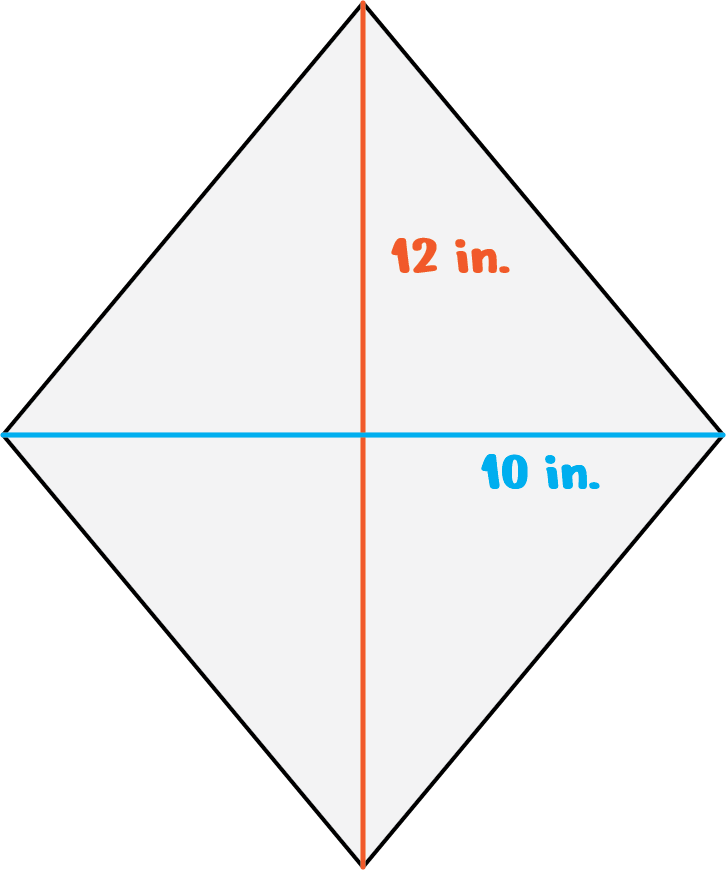
We are given a rhombus with diagonals measuring \(12\) inches and \(10\) inches. We want to find the area of this rhombus using an area formula involving diagonals.
To solve this problem, we need to recall the formula for the area of a rhombus when its diagonals are provided:
where:
– \(A\) is the area of the rhombus
– \(d_1\) is the length of the first diagonal
– \(d_2\) is the length of the second diagonal
If we let \(d_1=12\) and \(d_2=10\), we can substitute these values into the formula to find the area of the rhombus.
\[ A = \frac{1}{2} \times 12 \times 10 \]Upon simplification, we get
\[ A = \frac{1}{2} \times 120 = 60 \]Therefore, the area of the rhombus is \(60\) square inches.
Example 5: Find the area of the rhombus below.

Be careful not to assume that the lengths of the two diagonals are \(2\) meters and \(6\). It’s important to note that the given measurements represent parts of each diagonal. In fact, these measurements are only half of the full lengths of the diagonals.
The measure of half of the vertical diagonal (blue) is \(2\) \(\text{m}\) which means the full length of the vertical diagonal is \(4\) \(\text{m}\).
Similarly, the measure of half of the horizontal diagonal (orange) is \(6\) \(\text{m}\) which means the full length of the horizontal diagonal is \(12\) \(\text{m}\).
We can let \(d_1=4\) and \(d_2=12\), thus:
\begin{align*} A &= {1 \over 2}{d_1}{d_2} \\ & = {1 \over 2}\left( 4 \right)\left( {12} \right) \\ & = {1 \over 2}\left( {48} \right) \\ & = 24 \\ \end{align*}Therefore, the area of the rhombus is \(24\) \(\text{m}^2\).
Example 6: Given that the area of a rhombus is \(96\) square centimeters and one of its diagonals measures \(12\) centimeters, find the length of the other diagonal.
Recall that the formula to find the area of rhombus is
\[ A = \frac{1}{2}d_1d_2 \]Given that we have the area of the rhombus and the length of one of its diagonals, we can plug these values into the formula and solve for the missing diagonal.
\begin{align*} &A = 96 \\ & {d_1} = 12 \\ \\ A &= {1 \over 2}{d_1}{d_2} \\ \\ 96 &= {1 \over 2}\left( {12} \right)\left( {{d_2}} \right) \\ \\ 96 &= 6{d_2} \\ \\ {{96} \over 6} &= {d_2} \\ \\ 16 &= {d_2} \\ \end{align*}Therefore, the length of the other diagonal is \(16\) cm.