Angle Pairs
Angle pairs are two angles that share a unique or specific relationship. These relationships can depend on their measurements and how they are positioned relative to one another (orientations). In this lesson, we’ll explore different types of angle pairs to understand how their relationships differ.
1. Adjacent Angles
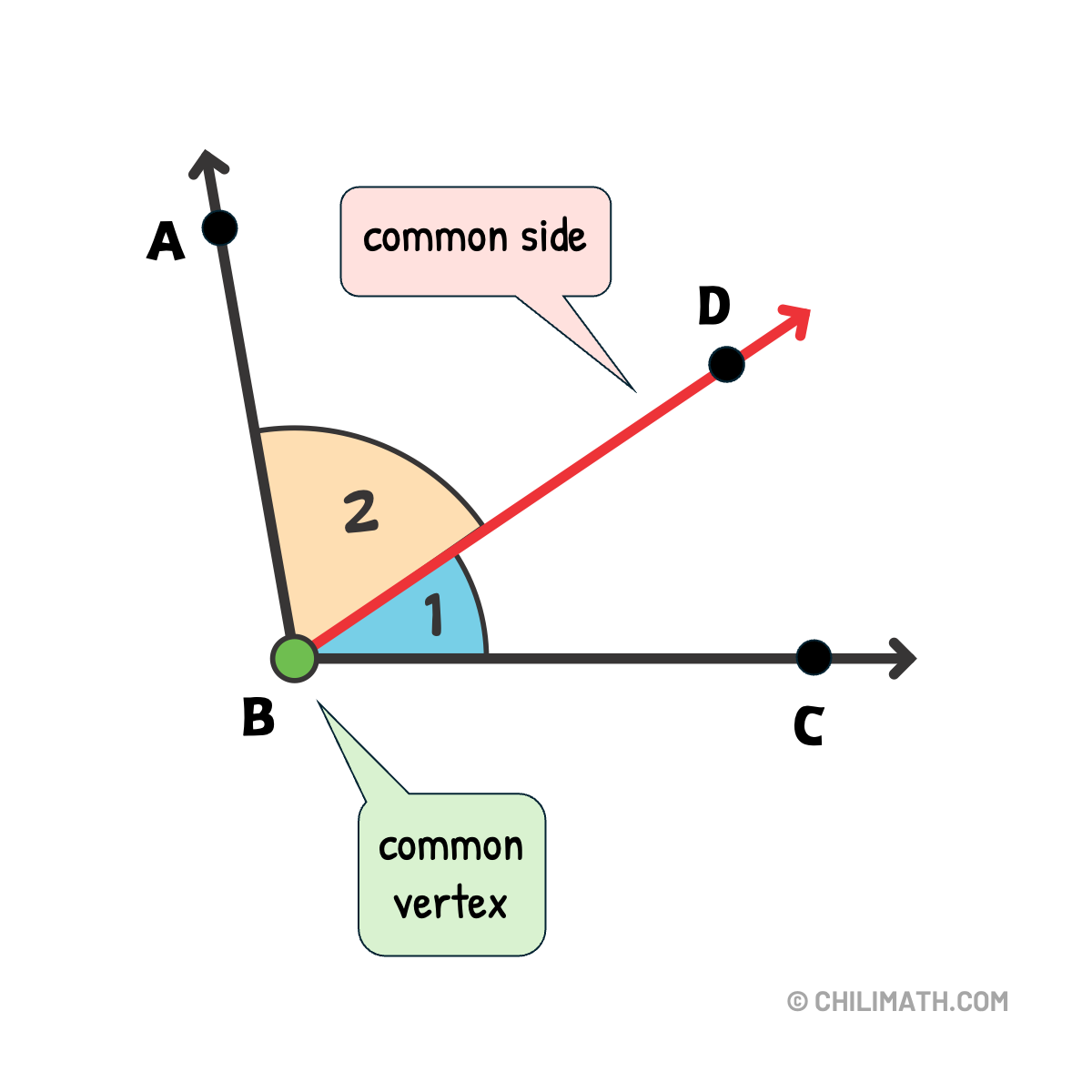
Adjacent angles are two angles that share a common vertex and a common side. However, they don’t overlap, meaning they don’t share any common interior points.
In the example below, \(\angle\)ABD or \(\angle\)2 and \(\angle\)DBC or \(\angle\)1 are adjacent angles because they share a common vertex at point \(B\) and the common side \(\overrightarrow{\rm BD}\). Notice, the two angles don’t overlap which means they don’t share common interior points.
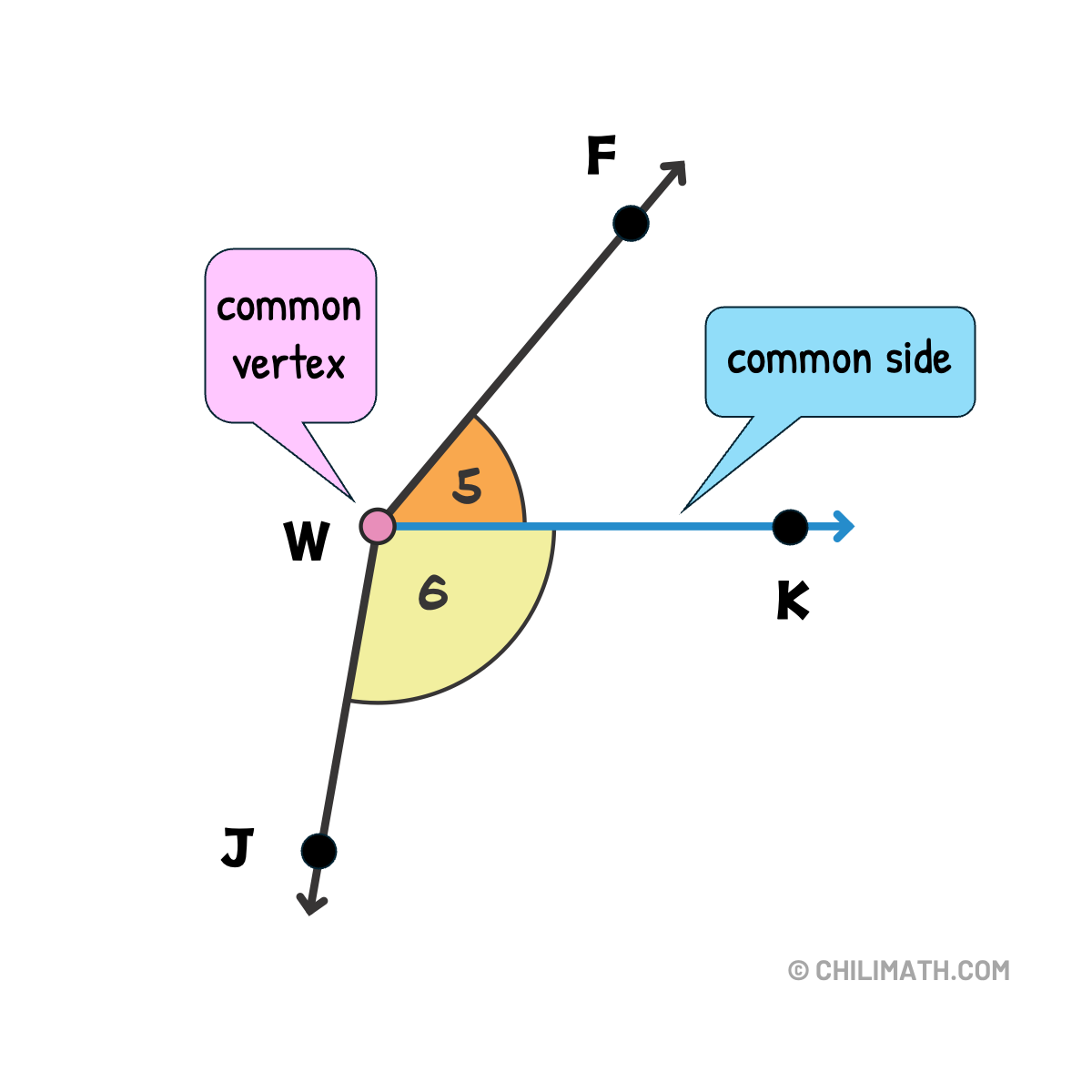
Here’s another example of adjacent angles that form an obtuse angle. The two angles that are adjacent are \(\angle\)FWK or \(\angle\)5 and \(\angle\)KWJ or \(\angle\)6.
2. Complementary Angles
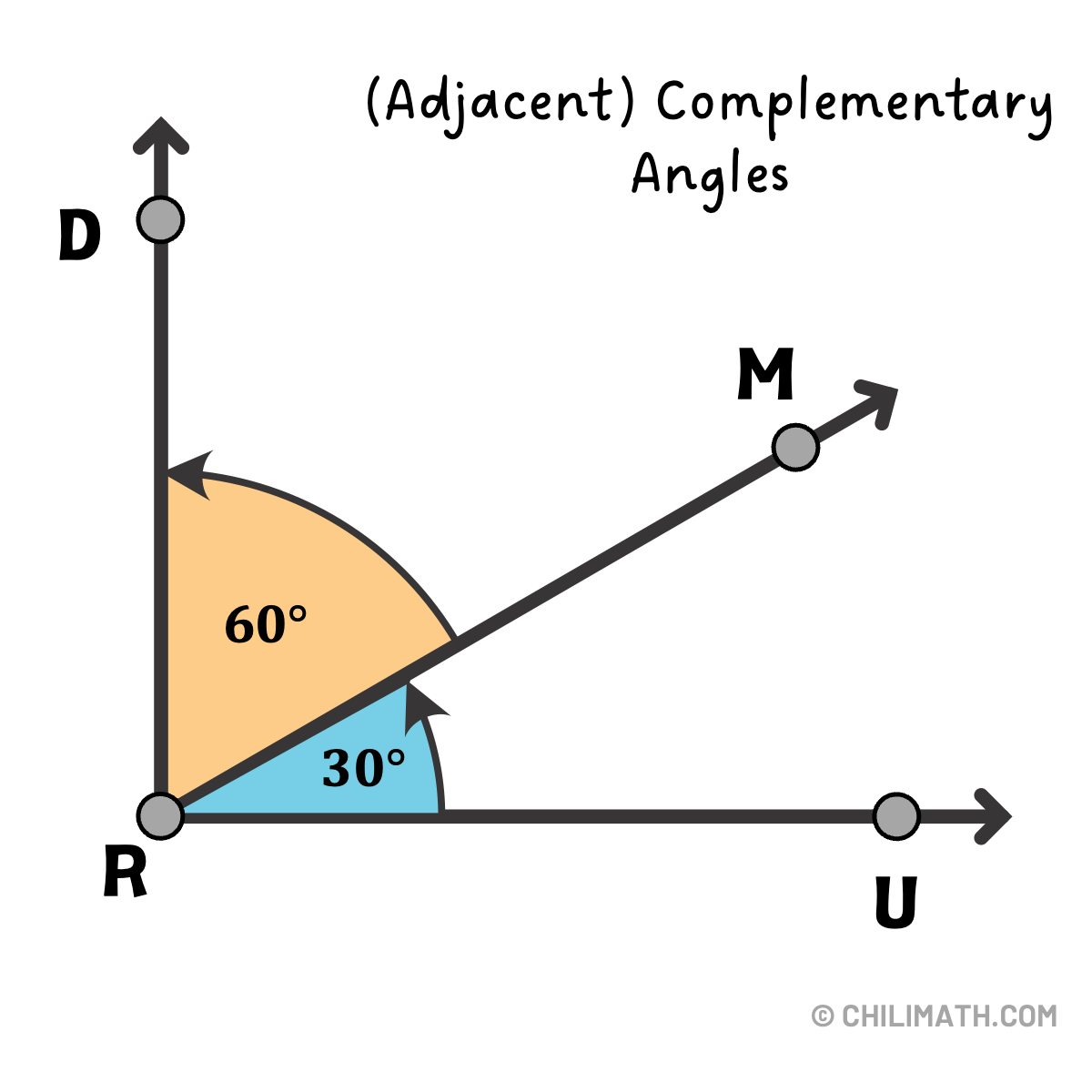
Complementary angles are a pair of angles whose measures add up exactly to \(90\) degrees. When the two complementary angles are adjacent, they form a right angle.
In the case below, \(\angle\)DRM and \(\angle\)MRU are adjacent angles since they both have the same vertex \(R\) and share the common side \(\overrightarrow{\rm RM}\). They are also complementary angles because the sum of their angles is \(90^\circ\). That is, m\(\angle\) DRM \(= 60^\circ\) and m\(\angle\) MRU \(= 30^\circ\), therefore,
m\(\angle\) DRM \(+\) m\(\angle\) MRU \(=\) \(60^\circ\) \(+\) \(30^\circ\) \(=\) \(90^\circ\)
Complementary angles don’t necessarily have to be adjacent to each other. Take a look at the example below.
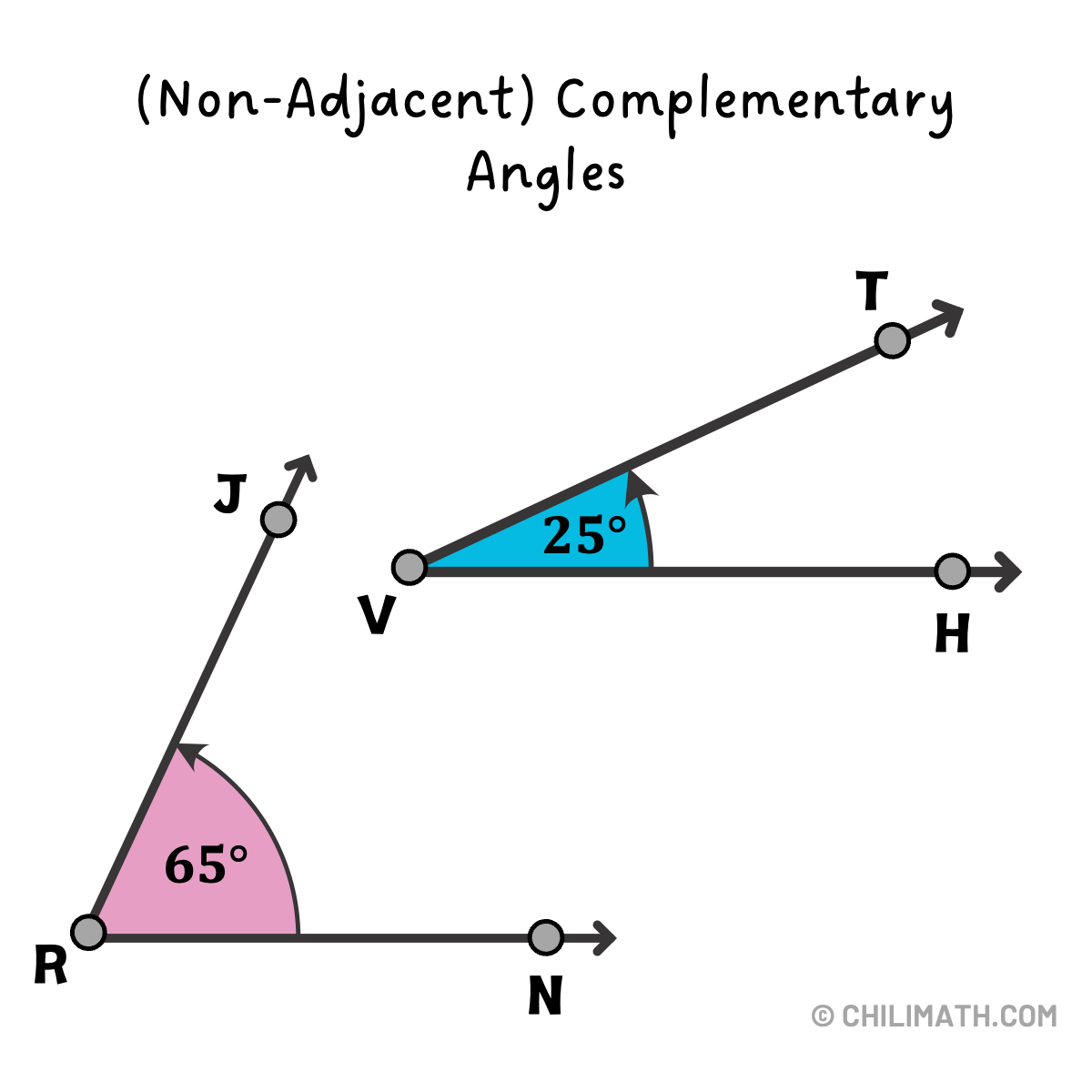
Observe that \(\angle\)TVH and \(\angle\)JRN are not adjacent angles yet complementary because their angle measures add to \(90^\circ\).
m\(\angle\) JRN \(+\) m\(\angle\) TVH \(=\) \(65^\circ\) \(+\) \(25^\circ\) \(=\) \(90^\circ\)
3. Supplementary Angles
Complementary angles are a pair of angles whose measures add up exactly to \(180\) degrees. When the two supplementary angles are adjacent, they form a straight angle which looks like a straight line.
The diagram below provides a clear example of adjacent supplementary angles, which are two angles that share a common vertex and a common side, with their measures adding up to exactly \(180^\circ\). In this case, the two angles are \( \angle SKC \), which measures \(120^\circ\), and \( \angle CKP \), which measures \(60^\circ\). The point where these two angles meet is the common vertex, labeled as \( K \), and the side that both angles share is the ray \( \overrightarrow{KC} \) extending from the vertex. These angles are adjacent because they are positioned directly next to each other without overlapping, and they are supplementary because the sum of their measures equals \(180^\circ\). To confirm this, we add their measures: \( \angle SKC + \angle CKP = 120^\circ + 60^\circ = 180^\circ \). This calculation verifies that these two angles satisfy the condition of being supplementary.

Just like complementary angles, supplementary angles don’t need to be adjacent. An example is shown below.
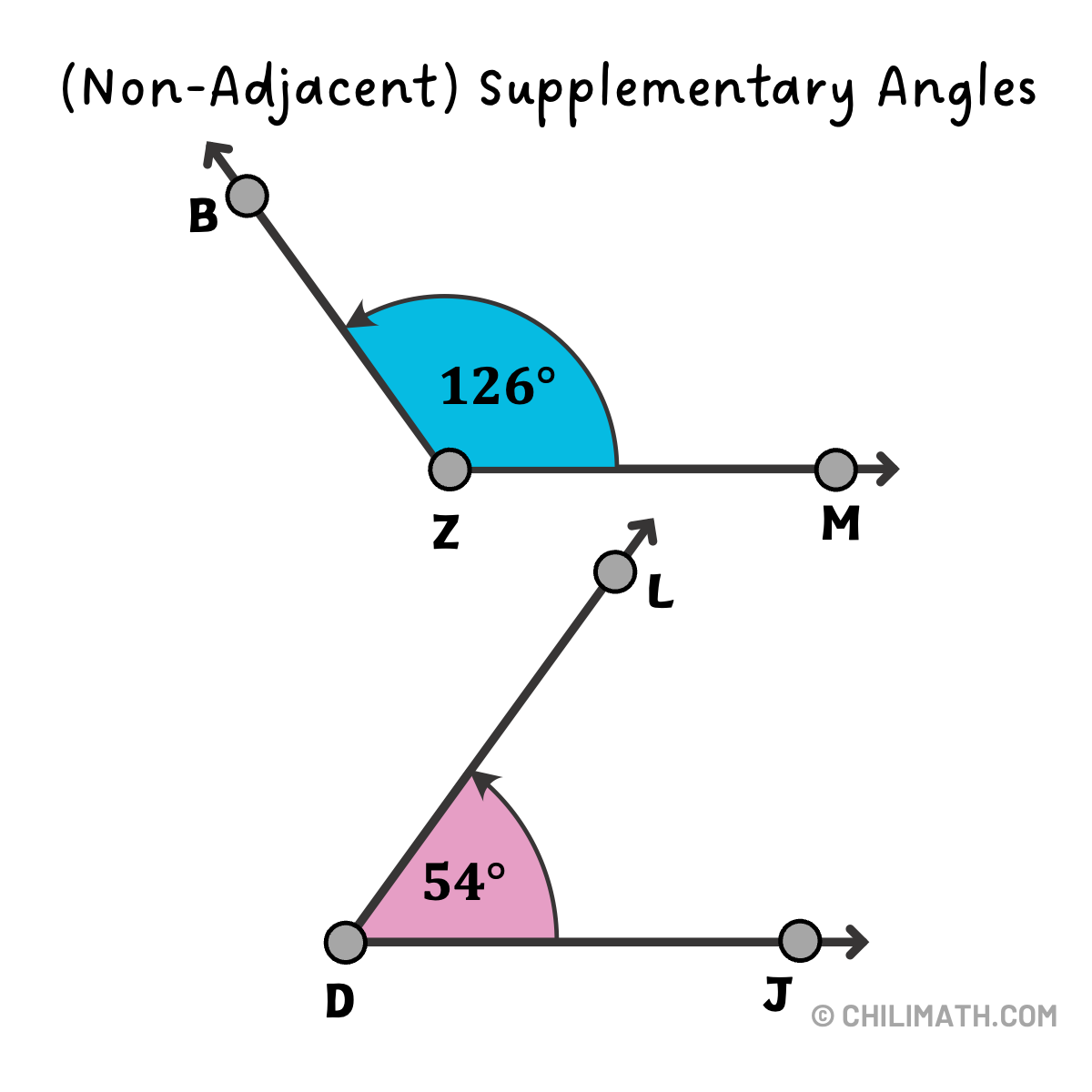
The two angles are supplementary because their measures add up to \(180^\circ\), which is the defining characteristic of supplementary angles. The first angle measures \(126^\circ\) (shown in blue), while the second angle measures \(54^\circ\) (shown in pink). Adding these together results in \(126^\circ + 54^\circ = 180^\circ\), confirming that they are supplementary. Although the angles are not adjacent, they still meet the requirement of being supplementary due to their total measure of \(180^\circ\). This provides a clear example of non-adjacent supplementary angles.
4. Linear Pair
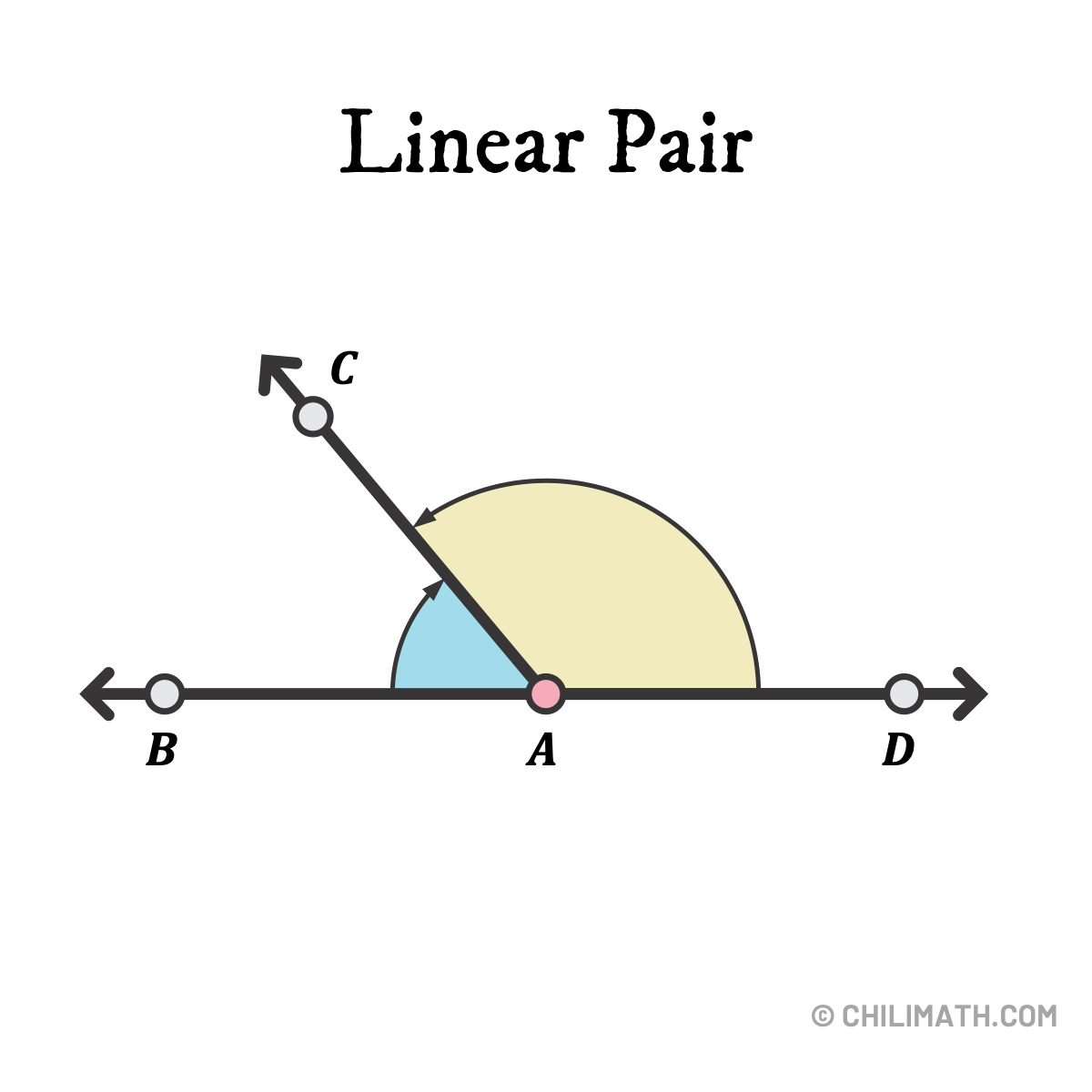
A linear pair is a pair of two angles that are adjacent and supplementary.
Let’s quickly go over the definitions what it means to be adjacent and to be supplementary.
- adjacent angles – two angles that share the same vertex, share the same side, and don’t overlap
- supplementary angles – two angles whose measures add up to \(180 ^\circ\)
In the example below, the angles \(\angle CAB\) (blue) and \(\angle CAD\) (yellow) form a linear pair. They share a common vertex at point \(A\) and a common side, ray \(\overrightarrow{AC}\). Their non-common sides, ray \(\overrightarrow{AB}\) and ray \(\overrightarrow{AD}\), form a straight line, ensuring that the two angles together add up to \(180^\circ\), making them supplementary. A linear pair like \(\angle CAB\) and \(\angle CAD\) is simply two adjacent angles that combine to create a straight line.
5. Vertical Angles
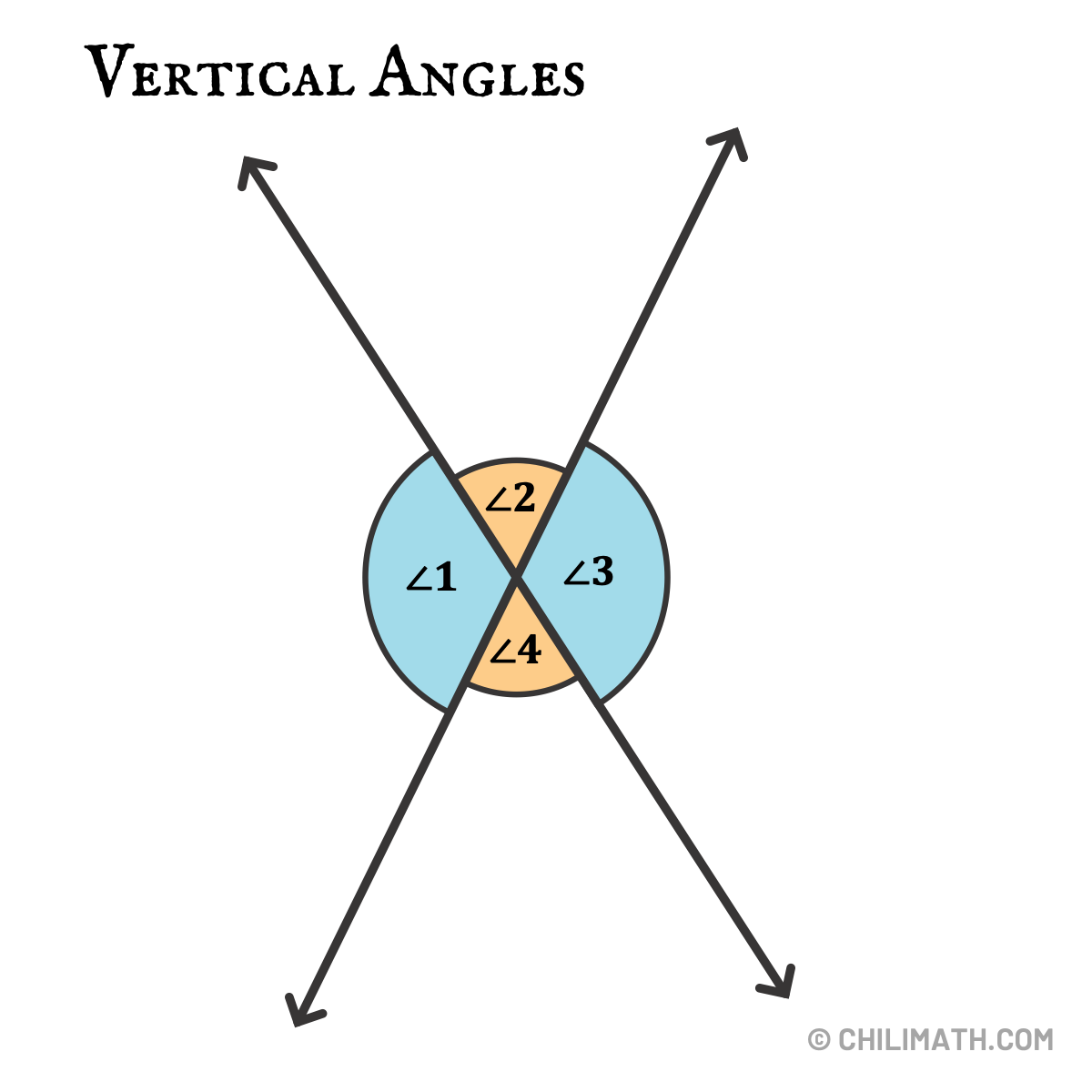
When two lines intersect, they form two pairs of vertical angles. These angles are opposite each other, not adjacent, and share a common vertex.
In the example below, the two pairs of vertical angles are \( \angle 1 \) and \( \angle 3 \), and \( \angle 2\) and \( \angle 4 \). These angles are nonadjacent, directly opposite each other and sharing the same vertex. One key property of vertical angles is that they are always congruent, meaning they have equal measures.