
Angle Addition Postulate
If a point O lies in the interior of \(\bold{\angle}\)ABC, then m\(\bold{\angle}\)ABO \(+\) m\(\bold{\angle}\)OBC \(=\) m\(\bold{\angle}\)ABC.

Examples of Angle Addition Postulate
Example 1: Find m\(\bold{\angle}\)CMK. See diagram below.

To solve for the measure of \(\angle\)CMK, we can apply the Angle Addition Postulate, which states that if a point lies in the interior of an angle, the measure of the larger angle is the sum of the measures of the two smaller angles.
According to the diagram, point \(P\) lies on the interior of \(\angle\)CMK. Therefore, the sum of \(\angle\)CMP and \(\angle\)PMK will give us the measure of the entire angle \(\angle\)CMK.
We know the values of the two smaller angles namely \(\angle\)CMP and \(\angle\)PMK.
\begin{align*} m\angle CMP = 53^\circ \\ m\angle PMK = 30^\circ \end{align*}We just need to add the smaller angles to get the measure of the entire angle, \(\angle\)CMK.
\begin{align*} m\angle CMK &= m\angle CMP + m\angle PMK \\ &= 53^\circ + 30^\circ \\ m\angle CMK &= 83^\circ \end{align*}Therefore, the measure of \(\angle\)CMK is \(83^\circ\).
Example 2: If m\(\bold{\angle}\)JEH \(=\) \(137\) \(^\circ\), find m\(\bold{\angle}\)JEF. See diagram below.
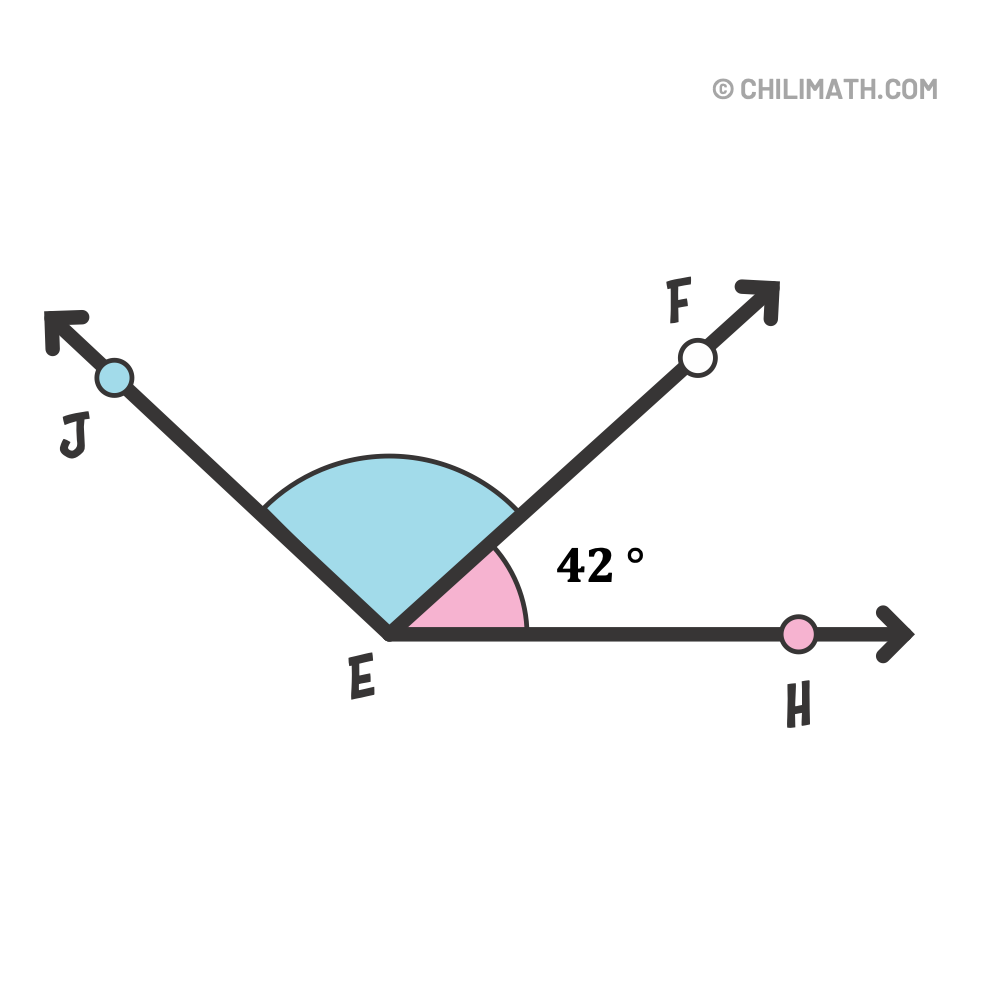
We are given the measure of angle \( \angle JEH = 137^\circ \), and we need to find the measure of angle \( \angle JEF \).
To solve this, we’ll use the Angle Addition Postulate, which states that the sum of adjacent angles equals the larger angle they form.
We know that \( \angle JEH \) is made up of two smaller adjacent angles: \( \angle JEF \) and \( \angle FEH \).
According to the problem, \( \angle FEH = 42^\circ \), and we are tasked with finding \( \angle JEF \).
Let’s set up the equation using the Angle Addition Postulate.
\(\angle JEH = \angle JEF + \angle FEH\)
Substituting the known values:
\(137^\circ = \angle JEF + 42^\circ\)
To isolate \( \angle JEF \), subtract \( 42^\circ \) from both sides of the equation.
Therefore, the measure of \(\angle\)JEF is \(95^\circ\).
Example 3: If m\(\bold{\angle}\)TYW \(=\) \(124\) \(^\circ\), find m\(\bold{\angle}\)TYA. See illustration below.

To solve this problem, we’ll use the Angle Addition Postulate, which states that if a point lies in the interior of an angle, then the sum of the two smaller angles formed is equal to the larger angle.
Let’s identify the angles involved. These are the values that we know.
\begin{align*} \angle \text{TYW} &= 124^\circ \\ \angle \text{TYA} &= (3x + 5)^\circ \\ \angle \text{AYW} &= 32^\circ \end{align*}Here, we are tasked with finding the measure of \(\angle \text{TYA}\).
According to the postulate, we have
m\(\angle\)TYW \(=\) m\(\angle\)TYA + m \(\angle\)AYW
Substituting the known values into the equation
\(124 = (3x + 5) + 32\)
Let’s combine like terms.
\begin{align*} 124 &= 3x + 5 + 32 \\ 124 &= 3x + 37 \end{align*}Subtract \(37\) from both sides then divide by \(3\)
\begin{align*} 124 &= 3x + 37 \\ 124 -37&= 3x + 37-37 \\ 87&=3x \\ 29&=x \end{align*}
We can find the measure of \(\angle\)TYA by substituting \(x = 29\) into \(\angle\)TYA \(= 3x + 5\)
Therefore, the measure of \(\angle\)TYA is \(92^\circ\).
Example 4: If the measure of reflex angle \(\bold{\angle}\)DOQ \(=\) \(228\) \(^\circ\), find m\(\bold{\angle}\)AOQ and m\(\bold{\angle}\)AOD. See the illustration below.
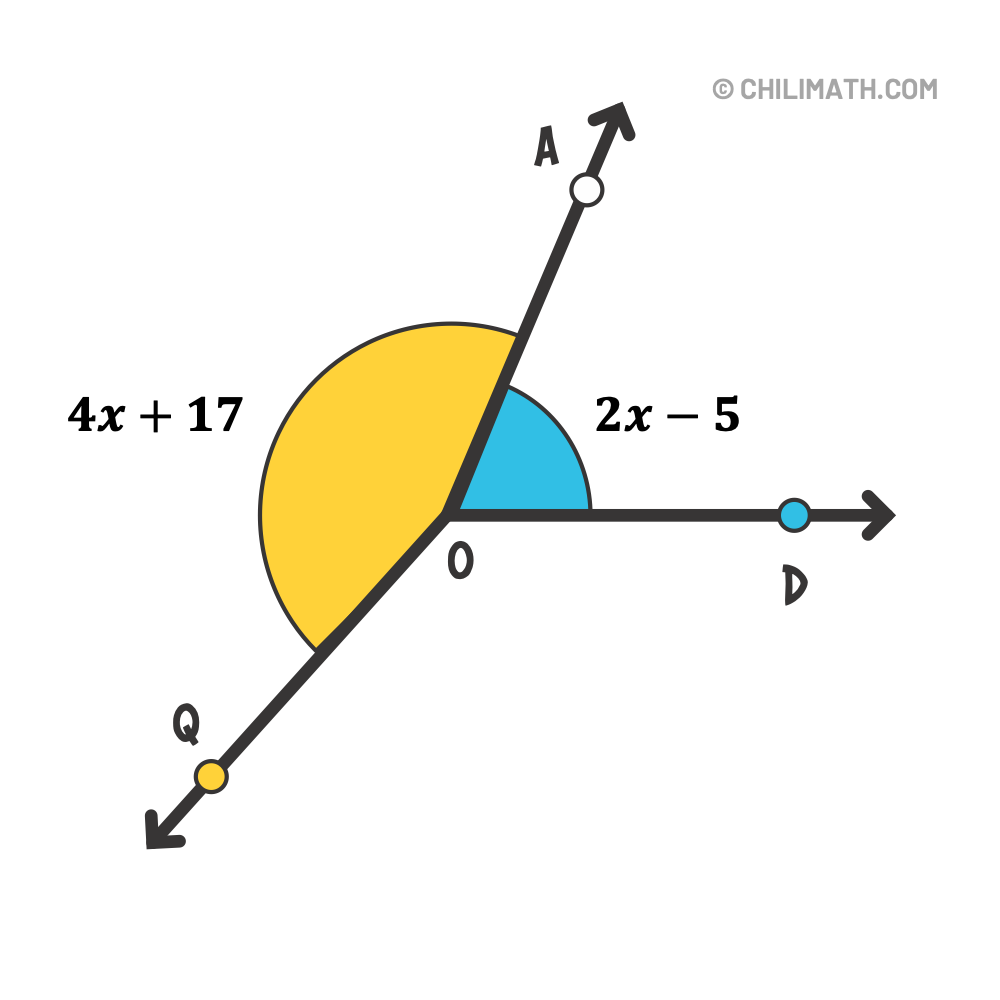
Let’s methodically solve this problem step-by-step to find the measures of \(\angle\)AOQ and \(\angle\)AOD using the given information and Angle Addition Postulate.
We are given that the measure of the reflex angle \(\angle\)DOQ is \(228^\circ\). It’s important to remember that a reflex angle is one that measures more than \(180^\circ\). So, in this case, \(\angle\)DOQ represents the larger angle that wraps around more than a straight line.
From the diagram, we know the following angle measures written as algebraic expressions.
\(\angle AOQ = 4x + 17\)
\(\angle AOD = 2x – 5\)
Since these two angles, \(\angle\)AOQ and \(\angle\)AOD, together form the reflex angle \(\angle\)DOQ, we can directly set up the equation using the Angle Addition Postulate:
\(\angle\)AOQ \(+\) \(\angle\)AOD \(=\) \(\angle\)DOQ
Let’s substitute the known values into the equation.
\((4x + 17) + (2x – 5) = 228^\circ\)
Now, let’s combine like terms. Next, we need to isolate \(x\) by subtracting \(12\) from both sides. Finally, divide both sides by \(6\) to solve for \(x\).
Since, we already know the value of \(x\), we can use it to find the angle measures of \(\angle\)AOQ and \(\angle\)AOD.
To find \(\angle\)AOQ, we have
\begin{align*} \angle AOQ &= 4x + 17 \\ &= 4(36) + 17 \\ &= 144 + 17 \\ &= 161^\circ \end{align*}To find \(\angle\)AOD, we have
\begin{align*} \angle AOD &= 2x -5 \\ &= 2(36) – 5 \\ &= 72 – 5 \\ &= 67^\circ \end{align*}Therefore, the measures of \(\angle\)AOQ and \(\angle\)AOD are \(161^\circ\) and \(67^\circ\), respectively.
Example 5: If m\(\bold{\angle}\)VBP \(=\) \(9x-13\) \(^\circ\), find m\(\bold{\angle}\)VBM, m\(\bold{\angle}\)MBP, and m\(\bold{\angle}\)VBP. See the illustration below.

Let’s solve this problem step-by-step using the Angle Addition Postulate. This is the information that we know.
We need to find the measures of \( m\angle VBM \), \( m\angle MBP \), and \( m\angle VBP \).
According to the Angle Addition Postulate, the sum of the two smaller angles \( m\angle VBM \) and \( m\angle MBP \) is equal to the larger angle \( m\angle VBP \):
m\(\angle\) VBM + m\(\angle\) MBP = m\(\angle\) VBP
Substituting the given values:
(\(6x + 6) + (2x – 1) = 9x – 13\)
Combining like terms.
\begin{align*} 6x + 6 + 2x – 1 &= 9x – 13 \\ 8x + 5 &= 9x – 13 \\ \end{align*}Subtract both sides by \(5\).
\begin{align*} 8x + 5-5 &= 9x-13-5 \\ 8x &= 9x-18 \\ \end{align*}Subtract both sides by \(9x\).
\begin{align*} 8x &= 9x-18 \\ 8x-9x &= 9x-9x-18 \\ -x&=-18 \end{align*}Finally, divide both sides by \(-1\).
\begin{align*} -x&=-18 \\ -x/(-1)&=(-18)/(-1) \\ x&=18 \end{align*}After knowing the value of \(x\), it is now possible to find the measures of the three (3) angles.
- To find the measure of \(\angle\)VBM:
\(m\angle VBM = 6x + 6 = 6(18) + 6 = 108 + 6 = 114^\circ\)
- To find the measure of \(\angle\)MBP:
\(m\angle MBP = 2x – 1 = 2(18) – 1 = 36 – 1 = 35^\circ\)
- To find the measure of \(\angle\)VBP:
\(m\angle VBP = 9x – 13 = 9(18) – 13 = 162 – 13 = 149^\circ\)
Therefore, the final answers are as follows:
\begin{align*} m\angle VBM &= 114^\circ \\ m\angle MBP &= 35^\circ \\ m\angle VBP &= 149^\circ \end{align*}